Before Machines: Coffee as Culture, Not a Device
Before coffee became a matter of grams, ratios, and extraction curves, it was something simpler—and arguably more powerful.
Coffee was boiled, settled, poured, and shared.
There were no machines. No filters. No precision tools. Coffee was a cultural act, not a technical one. Across Africa, the Middle East, and Asia, early brewing methods focused on hospitality, ritual, and conversation rather than clarity or consistency.
This is where coffee brewing truly begins.
Ethiopian & Arabian Boiled Coffee
Before Filters Existed
Coffee’s earliest brews came from Ethiopia and Yemen, where coffee cherries were first cultivated and consumed. Brewing was straightforward: ground coffee was boiled directly in water, often in clay or metal vessels.
The grounds were allowed to sink naturally. No separation was needed.
What mattered wasn’t sediment—it was strength, warmth, and togetherness. Coffee was prepared in communal settings, shared in small cups, and brewed multiple times from the same grounds as a sign of generosity.
This approach shaped every brewing method that followed.
Turkish, Greek & Middle Eastern Coffee (Ibrik / Cezve)
The World’s Oldest Brewing Method (16th Century)
By the 16th century, coffee had spread across the Ottoman Empire, where it evolved into what we now call Turkish or Greek coffee.
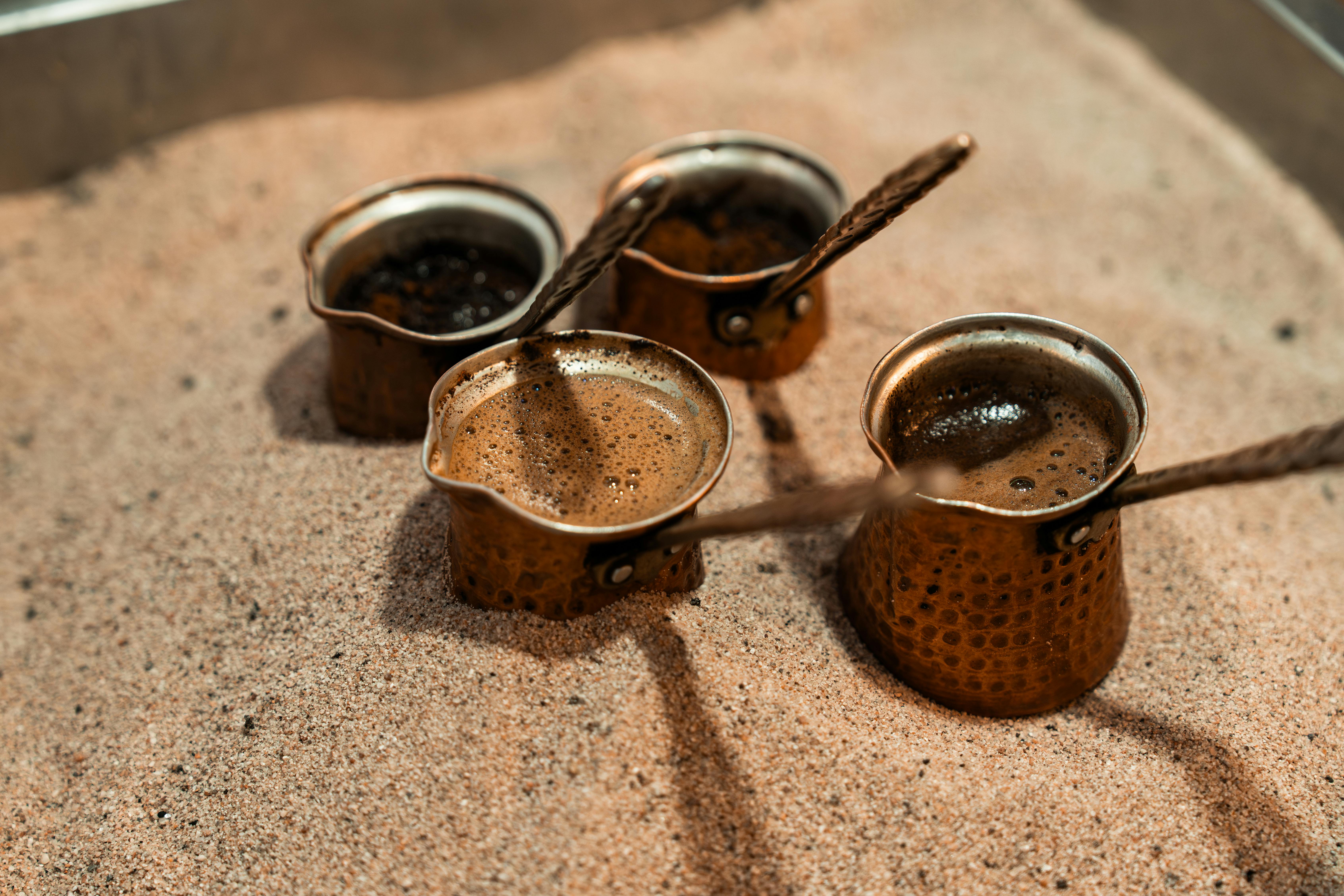
Finely ground coffee was simmered with water—sometimes sugar or spices—in a small metal pot known as an ibrik (or cezve). The coffee was never filtered. Instead, foam was carefully raised and preserved, and the grounds settled at the bottom of the cup.
In some regions, the ibrik was placed directly into hot sand, allowing slow, even heat. This sand-brewing technique wasn’t just functional—it was theatrical, turning coffee preparation into a performance.
And when the cup was empty, the grounds left behind were often used for fortune telling, reinforcing coffee’s role as something mystical, social, and deeply human.
Ottoman Coffeehouses
The Birth of Cafés—and Why Coffee Was Once Banned
As coffee spread, it gave rise to the world’s first coffeehouses: Ottoman qahveh khaneh.
These spaces became hubs of:
- Conversation
- Poetry and music
- Chess and backgammon
- Political discussion
Coffeehouses were so influential that authorities periodically tried to ban them, fearing that coffee fueled dissent and independent thought. At times, coffee itself was declared illegal.
It didn’t work.
People kept drinking it anyway.
Coffee had already proven something important: it wasn’t just a beverage—it was a social technology.
Thai Sock Coffee (กาแฟถุง)
From Roadside Stalls to Daily Ritual
In Thailand, coffee took on a form that still feels instantly familiar today.
Known as กาแฟถุง (sock coffee), this method uses a cloth filter stretched over a metal ring. Hot water is poured directly over the grounds, producing a bold, full-bodied brew.
Sock coffee is everywhere in Thailand:
- Morning street carts
- Local markets
- Roadside cafés
For decades, it has represented accessibility and routine—coffee for workers, families, and communities. Today, even specialty cafés are re-embracing cloth filtration for its ability to highlight body and sweetness.
It’s a reminder that traditional methods don’t disappear—they adapt.
Indonesian Tubruk
Grounds in the Cup, On Purpose
Across Indonesia, millions still drink coffee the simplest way possible.
Tubruk coffee is made by placing ground coffee directly into a cup, pouring hot water over it, and waiting. The grounds settle naturally. No filter is used.The result is intense, earthy, and unapologetically bold.
Tubruk reflects a philosophy shared across early coffee cultures: clarity was never the goal. Flavor, warmth, and presence were.
One Shared Philosophy
From Ethiopian boiled coffee to Ottoman sand brewing, from Thai sock coffee to Indonesian tubruk, these methods all share one belief:
Coffee is not defined by machines.
It is defined by people.
Long before pressure, paper, and precision entered the picture, coffee was already doing what it was meant to do—bring people together.
Coming Next in the Series
In the next chapter, we’ll explore how metal, pressure, and paper changed coffee forever—from the Moka pot to the French press, and the beginning of brewing as engineering.
Because once coffee met machines, everything changed.